 26. May 2026
SLOW PRESS JUICER.
Fresh juice can be a convenient way to increase your daily intake of fruits and vegetables. However, the type of juicer you choose can significantly affect preparation time, juice quality, and extraction efficiency. Traditional centrifugal juicers use fast-spinning blades to process ingredients, while slow press juicers use low-speed masticating technology to slowly press and extract juice from fruits and vegetables such as celery, carrots, spinach, kale, and ginger. In this guide, we will take a closer look at the slow press juicer, including its features and advantages.
Features of the slow press juicer
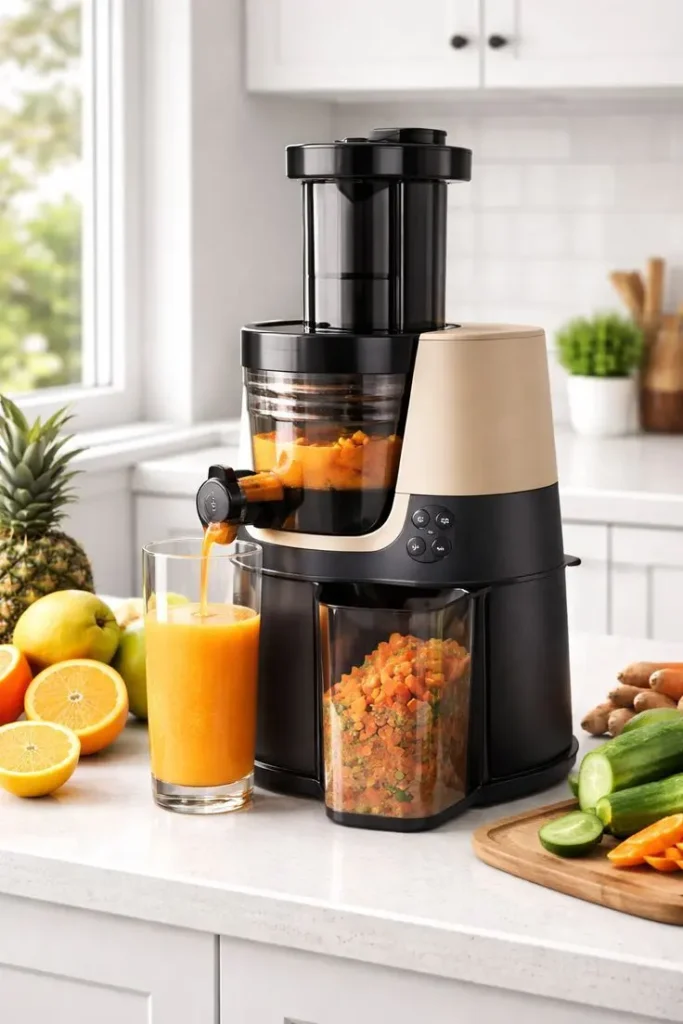
1. Low-speed cold-press mechanism (80 RPM)
This juicer uses a low-speed mastication mechanism operating at 80 RPM to mash and squeeze fruits and vegetables, rather than high-speed blades to achieve the same effect.
2. 4.1-inch rotary feed chute
This juicer has a huge 4.1-inch feed chute, which makes it easier to insert fruits and vegetables without having to chop them as much as usual. In addition, the rotary chute provides an additional level of safety.
3. Heavy-duty spiral auger
This 3.2 x 6.3-inch spiral auger crushes and presses produce to effectively extract juice from them. It is engineered for crushing and pressing fibrous produce like lettuce, celery, carrots, and ginger.
4. Easy clean modular design
With it modular design, it is easy to disassemble various parts of this juicer and clean them separately.
Benefits of the slow press juicer
- Requires less time for preparation: The 4.1-inch feed chute saves preparation time by letting you add larger fruits and vegetables with little or no chopping.
- Facilitates nutritional value preservation: The low-speed extraction method produces less heat during juicing, which helps preserve the nutrients in fruits and vegetables.
- Minimizes noise levels: It makes only limited noise due to its low speed; hence, you can enjoy your preparation time without any disturbance.
- Promotes efficient juice extraction: Through its mastication technique, the process of separating juice from pulp becomes easier and more efficient.
Conclusion
The slow press juicer presents an optimal combination of ease and efficiency for those who are habitual consumers of freshly squeezed juice. The product’s concept is oriented toward simplifying the process of juicing while achieving uniformity in results with different kinds of produce. See other products.
Sources