


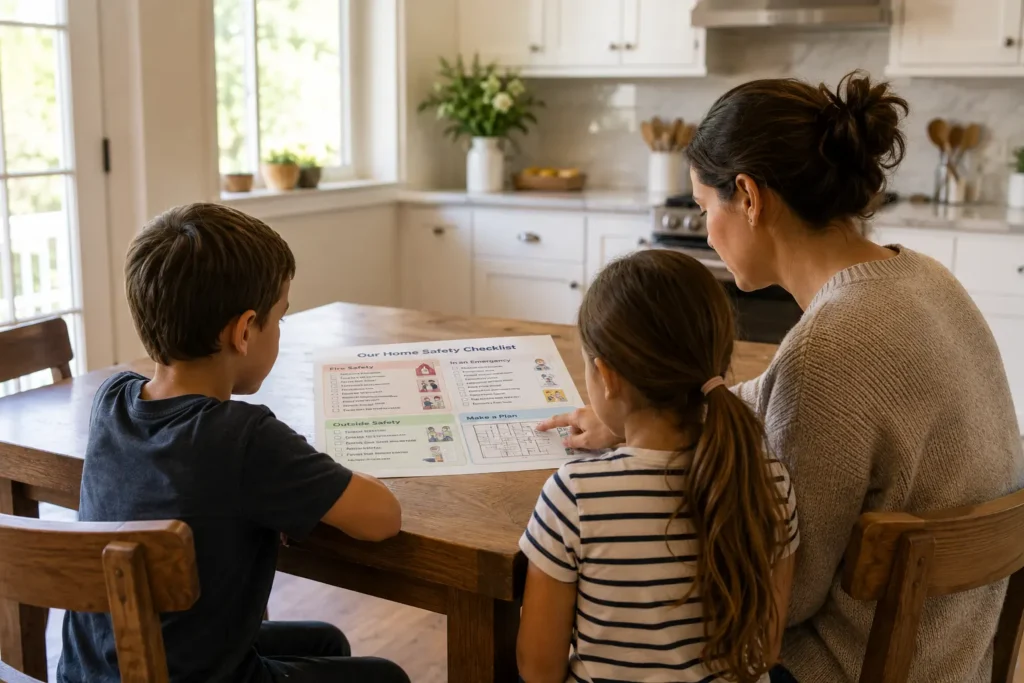

Children spend much of their early life at home; however, they are not prepared for emergencies such as fires, gas leaks, health problems, security issues, etc., that could occur in a domestic environment. When an emergency occurs, adults plan their actions, but children are vulnerable. Education on emergency management does not imply frightening them. It means helping children act safely without adult supervision. Practice enables children to remember all measures that should be taken during unexpected situations.
Emergency safety training programs should be age specific. It is difficult for three-year-olds and thirteen-year-olds to understand the same message in the same manner. Hence, different methods must be used to train young and old children.
How children learn about emergency safety
Understanding how kids learn about safety is important when teaching safety principles:
1. Preschoolers (ages 3-5)
Learning is done by repetition, play, and hands-on activities. It is best to keep messages short and use games, music, and practice over explanations.
2. Early elementary kids (ages 6-8)
These children can follow multi-step instructions and correctly carry out safety procedures.
3. Older kids (ages 9-12)
At this point, children are capable of critical thinking, such as ‘what if’ questions. Discussions based on scenarios are effective at this age.
4. Teenagers (ages 13-17)
At this age, teenagers have independent thoughts and can lead others. The major obstacle here is engaging teenagers as leaders.
Best Practices for teaching children about smoke emergencies
Teach children that smoke is more dangerous than fire
Many people think flames are the biggest danger in a fire, but smoke causes most fire-related injuries and deaths. Children should understand that smoke can make it difficult to see, breathe, and find a safe way out. Teach children that if they see or smell smoke, they should leave the area immediately and stay as low to the ground as possible.
Teach children to stay close to the floor and crawl during evacuation
Smoke rises during a fire, making the air closer to the floor safer to breathe. Children should learn and regularly practice crawling low to an exit during fire drills. For younger children, this is best taught as a simple, repeatable action: “When we smell smoke, we crawl low.” Older children can also be taught the reason behind it: heat, smoke, and toxic gases accumulate near the ceiling first, leaving cleaner air closer to the ground.
Teach children to check a door before opening it during a fire
Children aged six and older can learn to check a closed door before opening it if they suspect there is a fire. They should use the back of their hand to feel the door. If it feels warm or hot, there may be fire or smoke on the other side. In that situation, they should not open the door. Instead, they should find another safe way out or call for help. This simple safety skill can be practiced during fire drills by teaching children how to check doors before opening them, even when the doors are at normal room temperature.
Best practices for teaching kids about gas leaks and electrical hazards
Teach children to recognize early warning signs of danger
Children should learn to recognize common signs that something may be wrong in the home. These include the smell of gas, damaged electrical cords or outlets, and unusual hissing sounds coming from appliances or pipes. The goal is not to teach children how to identify or fix the problem. Instead, they should understand that these warning signs mean they need to stay away from the area and tell a trusted adult immediately. Children should never try to investigate or handle a potential hazard on their own.
Teach children to leave immediately and avoid contact with hazards
In case of any gas leak, remember never to switch on/off light switches, never to use any appliance, immediately exit the premises, and inform a responsible adult person or seek help from outside. Kids must know that they have no responsibility for checking or repairing anything. It is necessary to leave everything untouched and inform adults about the problem. The same principle works in case of any electrical hazard.
Best practices for teaching kids about medical emergencies
Teach children to recognize when an adult needs help
Children should be able to recognize visible signs that an adult may need emergency assistance: an unresponsive adult, who has fallen and cannot get up, who is having difficulty breathing, or who is bleeding heavily. Younger children can be taught through simple, matter-of-fact language. Older children can be introduced to a broader range of signs and taught the difference between situations that need urgent action and those that can wait.
Teach children to memorize important contact information
Every child should know their home address, at least one parent’s phone number, and how to dial emergency services. These should be practiced, not just listed on a refrigerator. For younger children, games and repetition help embed this information. For older children, having this knowledge committed to memory independent of a phone or list is an important goal.
Teach children when and how to call emergency services
Kids need to be aware that dialing for help from emergency services is acceptable in the case of danger to life in the absence of any adult assistance. They need to learn what they must say to such operators: their names, addresses, and the nature of the problem, along with informing them about being kids. Practicing this exercise through a role-play exercise, without actually calling up the number of the emergency service providers, gives kids the confidence to deal with a real-life situation.
Best practices for teaching kids about home security emergencies
Teach children safety rules when home alone
Children who are home alone should know a basic set of rules: do not open the door to strangers, do not announce they are alone to anyone who calls or comes to the door, and know how to reach a trusted adult or emergency services. These rules should be rehearsed, not simply stated. Role-playing specific scenarios, such as a stranger knocking or an unexpected phone call, gives children a practiced response rather than a novel decision to make under pressure.
Teach children how to respond to unsafe situations
There needs to be a concrete guideline on what to do during those instances where things don’t fall under any of the established rules and when they feel unsafe. This involves going to their trusted neighbor or making calls to their parents or the authorities if necessary. It must also be remembered that there is no such thing as being too cautious in making these types of calls.
How to know a child understands emergency procedures
Children who have internalized emergency safety education typically demonstrate several markers of genuine understanding:
- They can explain safety steps in their own words without prompting.
- They can identify emergencies when described in a scenario and articulate what they would do.
- They can demonstrate procedures, escape routes, stop-drop-and-roll, and low crawling without needing to be reminded.
- They ask follow-up questions, which indicates engagement with the material rather than passive reception.
- They are calm rather than anxious when the topic arises, which reflects confidence rather than avoidance.
If a child cannot do these things, more practice is needed, not more information. The gap is almost always in repetition and reinforcement, not in the complexity of instruction.
Conclusion
Effective teaching of home emergencies is calm, age-appropriate, and repeated over time, building competence rather than fear. Children who know what to do in an emergency, and who have practiced doing it, are better equipped to protect themselves and help others when it matters.
Sources