


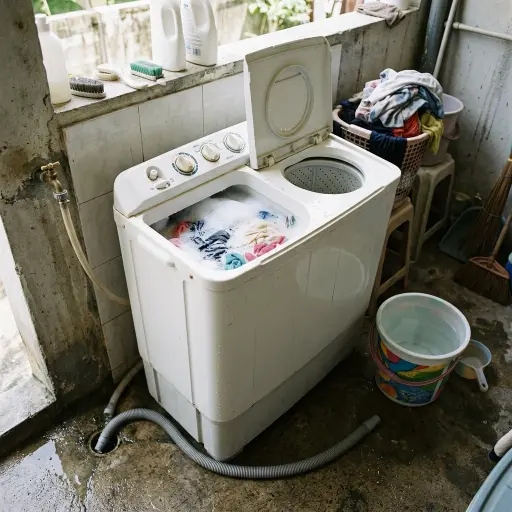

Washing machines use different mechanisms to clean clothes. Some use a rotating drum, others rely on an agitator or impeller, while semi-automatic models require users to handle certain stages of the washing process.
These differences affect how clothes are washed, how water enters and leaves the machine, and whether laundry needs to be transferred between compartments. Understanding how each type works makes it easier to choose a washing machine that suits a household’s needs.
Types of washing machine and what to consider before buying
1. Front-load washing machines
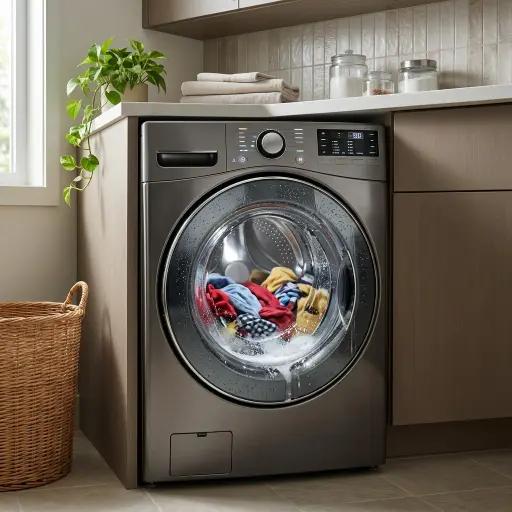
Front-load washing machines have a horizontal drum with a door at the front. Clothes are loaded through this door, and the drum rotates to lift and drop garments through water and detergent. This tumbling action helps remove dirt without requiring a central agitator.
Most front-load washing machines are fully automatic. After loading clothes, adding detergent, and selecting a wash programme, the machine handles the entire washing process.
Here is how a typical wash cycle works:
- Water intake: A hose connects the machine to a household water supply. When the cycle starts, an internal valve opens to let water into the drum.
- Washing: The drum rotates, lifting and dropping clothes through the water and detergent mixture.
- Draining: A pump removes the dirty, soapy water through the drainage hose.
- Rinsing: The machine automatically takes in fresh water to remove detergent and loosened dirt from the clothes. It then drains the rinse water. Some programmes include additional rinses.
- Spinning: The drum rotates at high speed to extract excess water from the laundry.
The machine draws fresh water directly from the connected household supply whenever it needs to rinse. Users do not have to pour water into it manually.
Front-load machines generally use less water than traditional top-load agitator models. They also provide more space-efficient installation options because compatible models can be stacked with a separate dryer.
Important: The final spin cycle does not completely dry clothes. Laundry still needs to be air-dried or transferred to a separate dryer.
2. Top-load washing machines
Top-load washing machines have a vertical drum with an opening at the top. Clothes are loaded from above, and the machine uses a washing mechanism to move garments through water and detergent.
There are two main types of top-load washing machines, distinguished by their washing mechanisms.
Top-load agitator washing machines
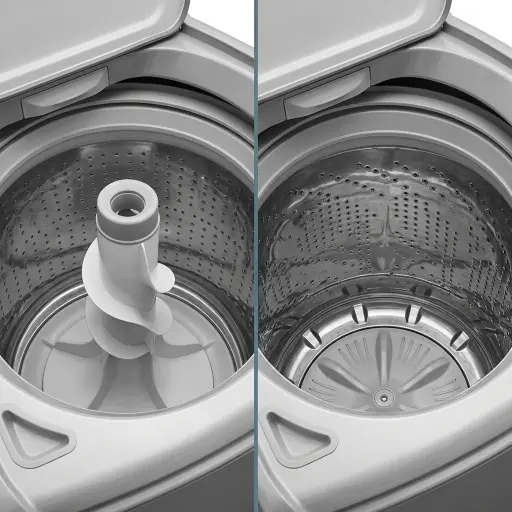
An agitator is a tall central post fitted with fins that moves back and forth during the wash cycle. Its movement creates friction and water circulation, helping to remove dirt from clothing.
The agitator takes up some space inside the drum and creates a more vigorous washing action. These machines typically have shorter wash cycles than many front-load models and are often less expensive than other fully automatic options.
Top-load impeller washing machines
An impeller is a low-profile rotating plate or cone located at the bottom of the drum. Instead of using a tall central post, it creates water movement that allows clothes to rub against one another during washing.
Without a central agitator, the machine provides more usable drum space for bulky laundry. Many high-efficiency impeller models also use sensors to adjust the water level according to the size of the load.
How do top-load washing machines rinse and spin clothes?
Both agitator and impeller models are available as fully automatic washing machines. Once a wash programme begins, they automatically take in water, wash the clothes, drain the dirty water, add fresh water for rinsing, and spin the laundry.
Like front-load machines, they connect to a household water supply through an inlet hose. They do not require manual water filling at every stage. Their spin cycles remove excess water but do not completely dry clothes. Laundry must still be air-dried or placed in a separate dryer.
The main difference between agitator and impeller models is how they move clothes during washing, not whether they can rinse or spin automatically.
3. Semi-automatic (twin-tub) washing machines
Semi-automatic washing machines have two separate compartments: a wash tub and a spin tub. Unlike fully automatic models, they require users to handle some stages of the washing process.
Here is how they work:
- Fill the wash tub: Add water and detergent to the washing compartment using a connected hose or a bucket.
- Wash the clothes: Load the laundry and select the desired wash duration.
- Drain the water: Empty the used water from the wash compartment using the drain selector or drainage hose.
- Rinse the clothes: Refill the wash tub with clean water and run a rinse cycle.
- Transfer the clothes: Move the rinsed laundry into the separate spin compartment.
- Spin the clothes: Run the spin cycle to extract excess water.
The spin compartment is sometimes called a dryer, but it does not use heat to dry clothes. It spins them rapidly to remove water, so the laundry still needs to be hung out to dry.
The main distinction is the manual operation. Users control water filling and draining, manage the rinsing process, and transfer clothes between compartments.
This design is useful in households where running water is unreliable or where manual control over water consumption is important.
4. All-in-one washer-dryer combos
Washer-dryer combos combine washing and drying functions in one appliance. Unlike ordinary front-load and top-load washing machines, they can wash and completely dry clothes without requiring a separate dryer.
The machine first washes and rinses the laundry, then spins out excess water before starting its drying programme.
Depending on the model, it uses condensation or heat-pump technology to remove moisture from the clothes. Users can select a wash-only programme or a combined wash-and-dry cycle.
However, drying capacity is often lower than washing capacity. A full wash load may therefore need to be reduced before drying. Combined wash-and-dry programmes can also take several hours.
This type is particularly useful for homes with limited space for separate washing and drying appliances.
Which washing machine should you buy?
The right washing machine depends on your water supply, laundry volume, available space, and how much manual involvement you prefer.
- For automatic washing: Choose a fully automatic front-load or top-load machine. Both handle washing, rinsing, draining, and spinning without manual transfers.
- For a traditional top-loading design: Consider an agitator model for its central-post washing mechanism or an impeller model for more usable drum space.
- For homes with unreliable water supply: A semi-automatic twin-tub machine allows manual water filling and draining.
- For washing and drying in one appliance: Choose a washer-dryer combo rather than an ordinary washing machine.
- For limited laundry space: Consider a front-load machine that can be stacked with a compatible dryer or an all-in-one washer-dryer.
Before purchasing a fully automatic machine, also check its water connection requirements and whether your household water supply can provide adequate pressure.
Conclusion
The main differences between washing machines lie in their loading designs, cleaning mechanisms, and level of automation.
Front-load machines use a tumbling action, while top-load models use either an agitator or an impeller to move clothes during washing. Both can automatically wash, rinse, drain, and spin laundry. Semi-automatic twin-tub machines require manual water filling and transferring clothes between compartments, while washer-dryer combos can wash and completely dry laundry in one appliance.
Understanding these differences makes it easier to compare washing machines and choose one that fits your household’s laundry requirements.
What type of washing machine do you currently use, and how has your experience been?
Sources: